
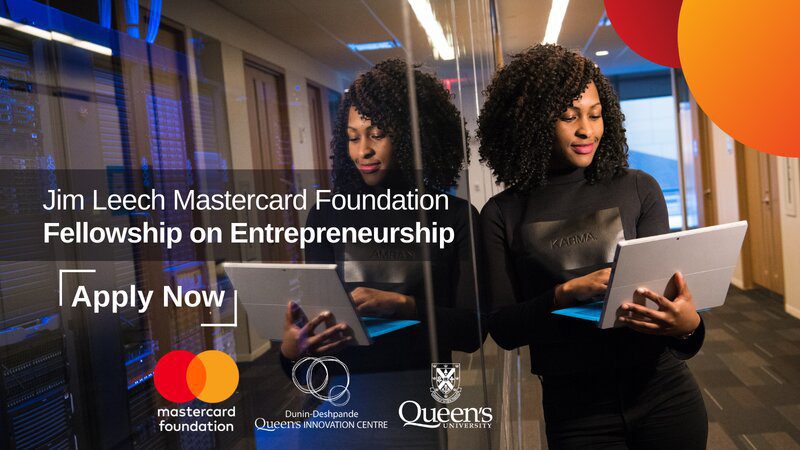
If you’re a student or recent graduate in Africa with an idea, a dream, or a venture in the making, then the Jim Leech Mastercard Foundation Fellowshi
If you’re a student or recent graduate in Africa with an idea, a dream, or a venture in the making, then the Jim Leech Mastercard Foundation Fellowship on Entrepreneurship (JL-MCF Fellowship) could be the springboard you’ve been waiting for.
In this guide, we’ll walk you through what the fellowship is, who can apply, how to apply (for the 2026 cohort), what’s in it for you, key deadlines, and tips for making your application stand out.
Think of this as your friendly companion to understanding and acting on this life-changing opportunity.
What is the Jim Leech Mastercard Foundation Fellowship?
The Jim Leech Mastercard Foundation Fellowship on Entrepreneurship is an initiative by the Mastercard Foundation, administered through the Dunin‑Deshpande Queen’s Innovation Centre (DDQIC) at Queen’s University.
As of the last known calls, the fellowship is aimed at African students or recent graduates (from any discipline) who want to develop entrepreneurial skills, build or scale a venture, and make social + economic impact.
Here are the key components in simple terms:
- Training & learning: You’ll go through online entrepreneurship courses (bootcamp style) with content derived from the “Disciplined Entrepreneurship” framework originally from the Massachusetts Institute of Technology (MIT).
- Mentorship & network: You’ll connect with mentors, coaches, current entrepreneurs, and a community of fellows from across Africa.
- Financial & opportunity support: Selected fellows may receive a stipend, pitch competition prizes (in some recent calls up to CAD $15,000), and sometimes travel/incubation opportunities.
- Inclusive & accessible: The fellowship emphasises inclusive participation particularly encouraging women, learners from diverse backgrounds, and different African countries.
In short: it’s more than just a scholarship. It’s an entrepreneurship acceleration programme with training, mentorship, network, funding and real support to build or scale your idea.
For the 2026 cohort, you’ll likely see a similar structure so starting early makes sense.
Why apply? What’s in it for you?
You might wonder: “What will I actually get if I apply and succeed?” Here are the major benefit categories spoken in plain language:
1. Skills & knowledge boost
If you’re just starting out or already working on a venture, the fellowship will give structured training. You’ll learn how to sharpen your business idea, identify a market, build a team, handle finances, pitch your venture, and more. You’ll have world-class input via Queen’s University/ DDQIC and mentors with real experience.
2. Mentorship & network
Being a fellow means you don’t go it alone. You’ll connect with other African entrepreneurs, mentors in North America and Africa, the global alumni network of Queen’s, and people who’ve “been there”. For example, graduates of the programme have gone on to win significant awards and scale their ventures.
3. Financial & exposure opportunities
Yes, there’s training and mentorship, but there’s also money and real opportunity. Recent calls offered stipends (CAD $500) and competition prizes (up to CAD $15,000) for selected finalists. Even if you don’t win big prize money, building a stronger, investable venture is itself a big benefit.
4. Credentials & credibility
Having the fellowship on your CV tells people you’ve been through a rigorous programme, you’ve committed time to entrepreneurship, you’ve been selected among peers. That opens doors funders, incubators, job opportunities, co-founders.
5. Impact & purpose
If you have a mission (for example: job creation, environmental sustainability, social justice) the fellowship is designed with impact in mind. The network, training and mentorship support not just business for profit, but business for purpose. For example, one fellow from Nigeria built an IoT/solar irrigation system for women farmers.
Who is eligible? Could you apply?
Here’s a breakdown of likely eligibility criteria based on recent calls (for 2025) and what to watch out for when the 2026 call opens.
Typical eligibility criteria
- You must be an undergraduate student or recent graduate (in Africa). The programme invites “students and recent graduates from all academic disciplines and from any African post-secondary institution”.
- You should have an interest (or a started venture) in entrepreneurship or want to develop one. A passion for solving challenges through innovation is key.
- Commitment to the programme: Historically, fellows committed at least about 10 hours per week during the online phases.
- Language requirement: The content is delivered in English. Mentorship may be offered in English and French, but assignments/pitches usually must be in English.
- Inclusivity: The fellowship emphasises broad access (all disciplines, all African countries), and especially encourages female applicants and under-represented backgrounds.
What it doesn’t always demand
- It’s often not restricted to one specific field (engineering, business, social sciences) — any discipline can apply.
- It may not require a fully formed venture. Some applicants may just have an idea and strong motivation.
- It’s typically open across Africa so your country being listed should not be a barrier if you meet other criteria.
What to check for 2026
When the 2026 call opens, you’ll want to check:
- The official deadline and application portal
- The exact stipend/prize amounts (may change)
- The phases of the programme (online + incubation or in-person)
- Whether there’s travel/incubation on campus or if fully virtual
- Any additional criteria (age limit? region? domicile?)
Bottom line: If you’re an African student or recent graduate with an entrepreneurial mindset, this fellowship is likely open to you.
If you’re unsure, it’s a good idea to pre-register for alerts on the programme website so you don’t miss any updates.
What does the fellowship involve? Key components
Here’s a step-by-step rundown of the typical programme structure (based on recent years) so you know what you’re getting into.
Phase 1 – Explore
- This is often the entry/online phase. Many applicants (sometimes 1,000+) get access to curated entrepreneurship courses. For example, 2021 edition: 1,252 students joined the training.
- You’ll learn the fundamentals, complete modules (such as the first 11 steps of the Disciplined Entrepreneurship framework).
- You’ll work on assignments, demonstrate your idea’s potential, build momentum.
Phase 2 – Ignite
- A smaller group is selected (e.g., 30 – 180) to move into deeper training, perhaps more intensive mentorship, more assignment deadlines, business model refinement, pitch prep.
- You may be required to refine your idea, create pitch decks, collaborate with your team (if applicable), demonstrate measurable progress.
Phase 3 – Launch / Fellowship & Incubation
- The finalists (sometimes up to ~60 in recent calls) become official “Fellows”. They may receive stipends, pitch competition opportunities, travel/incubation, and dedicated coaching.
- The final phase may run for several months (e.g., May-Aug) where you actively build/scale your venture, attend weekly sessions, get feedback, pitch for seed funding.
- At the end: Graduation, certification (micro‐credentials from Queen’s University), and continued alumni support.
Post-programme & alumni
- Even after your formal fellowship year, you remain connected through alumni networks, support opportunities, pitch competitions, mentoring future applicants.
- The experience and connections you build often continue to yield value beyond the duration.
Key deadlines and timing (for the 2026 cohort – what to expect)
While the exact 2026 schedule has not been publicly released (as of writing), let’s review recent patterns and what that suggests for your planning.
- For the 2025 cohort, applications closed on 4 December 2024.
- The programme phases typically start early in the year (Jan/Feb) for Phase 1, then March–April for Phase 2, then mid-year for final phase (May–August) in recent calls.
- Therefore, for 2026 you should start preparing now: once the call is open (likely Autumn prior year), you’ll need to submit by late year, then begin early the next year.
- Keep an eye on the official website of Queen’s University’s Innovation Centre (DDQIC) and Mastercard Foundation news for when the 2026 call is published.
Important tip: Set reminders, bookmark the link, and subscribe for updates. Early preparation gives you an edge.
How to apply: Step-by-step
Here’s a simplified, step-by-step guide to your application process so you’re not caught off guard.
- Visit the official programme page
Go to Queen’s University / DDQIC site for the Jim Leech Mastercard Foundation Fellowship. The link will have details for 2026 when open. >> https://www.queensu.ca/innovationcentre/programs/jim-leech-mastercard-foundation-fellowship-entrepreneurship) - Read the eligibility & requirements carefully
Make sure you meet the criteria (student or recent graduate, African country, entrepreneurial mindset, language ability). - Prepare your documents & materials
- Resume/CV: highlight education, experience, any venture or idea you’re working on.
- Motivation statement: why you want the fellowship, what you aim to do.
- Business idea/venture outline: even if you’re at idea stage, show your thinking, what problem you’re solving, your market/impact.
- Possibly team details (if you apply with team) and references or letters of recommendation.
- Complete the online application form
The form will ask for your personal details, educational background, your venture or idea details, commitment, and possibly your availability. - Submit by the deadline
Make sure all materials are uploaded, correct, and the form submitted before the cut-off. Late submissions usually aren’t accepted. - Prepare for assessments / phases
Once you submit, if selected you’ll enter Phase 1 (online training), then potentially Phase 2 (advanced training + selection) and Phase 3 (fellowship/incubation). Be ready for deadlines, group work, pitches, coaching. - If selected: Engage fully
If you get in, commit the time, attend workshops, work on your venture, pitch with impact. Use the mentorship and network. - After the programme: Leverage the network
Use the alumni network and the credentials you’ve gained to get funding, growth, partners, or employment.
Tips for a strong application
Here are some practical tips to help you maximise your chances of being selected:
- Be specific: Don’t just say “I want to start a business”. Explain the idea: what problem, for whom, why now, how you’ll solve it.
- Show potential for impact: This fellowship emphasises social & economic impact. Emphasise how your idea benefits your community or region.
- Demonstrate commitment: The programme requires about 10 hours/week. Show you are ready to commit—mention your schedule, readiness, why now is the time.
- Highlight your team or support: If you have a co-founder or mentor, or you’re working on your idea already, mention that.
- Use the language of entrepreneurship: Use terms like “scalable venture”, “business model”, “market validation”, “impact”.
- Tell your story: Why you? What drives you? A compelling personal story (especially if you overcame barriers) can help.
- Proofread & polish: Ensure your application is error-free; a professional presentation matters.
- Start early: Don’t wait for the last minute. Early preparation gives you better time to refine your idea.
- Leverage available info: Use the fact that past cohorts’ benefit information, timeline, etc. helps you frame your application.
- Plan your participation: Be ready for virtual learning, assignments, possibly meetings/follow-ups.
- Network while learning: Even if you’re not selected yet, start engaging your idea, a prototype, talk to mentors it boosts your readiness.
Frequently Asked Questions (FAQ)
Q: What is the duration of the fellowship?
A: Recent calls have indicated an 8-month timeframe, though still largely virtual or hybrid.
Q: Do I need to have a fully established business already?
A: Not necessarily. The programme is open to students and recent graduates with ideas or ventures at various stages. What matters is commitment and potential.
Q: Is the fellowship fully funded (travel, living costs)?
A: Past calls mention stipends (e.g., CAD $500) and pitch prizes (up to CAD $15,000). Travel/incubation opportunities exist but may depend on selection and funding.
Q: Can I apply if my venture is social-impact but not profit-focused?
A: Yes. The emphasis is on innovation and impact the venture can be financially sustainable while doing social good.
Q: What if I’m not fluent in English?
A: The programme is delivered in English and assignments/pitches must be in English. However, mentorship may support French speakers, and recently applicants were encouraged to form teams or use university support if language is a barrier.
Q: What happens after the programme?
A: You become part of the alumni network, may act as ambassador/mentor for future cohorts, and continue to access pitch + funding opportunities.
How to prepare now (for 2026)
Since the official 2026 call is likely to open soon, here’s how you can get ready:
- Polish your idea – Sketch out a business model: what problem you solve, who benefits, how you’ll generate revenue or sustainability, what stage you’re at.
- Get a team or mentor – Look for a co-founder, advisor, or someone experienced who can support you, even informally.
- Start a small prototype or pilot – Even minimal data or user feedback helps show you’re serious.
- Improve your English business language – Especially if it’s not your first language; watch videos, do mini-projects in English.
- Manage your schedule & commit time – If selected, you’ll invest at least ~10 hours/week; plan ahead (jobs, studies) so you can commit.
- Gather relevant documentation – CV, academic transcript, summary of your idea, photos/videos if you have them.
- Subscribe for updates – Go to the Queen’s University DDQIC site or Mastercard Foundation site to get alerts for the 2026 call.
- Network & learn – Attend entrepreneurship webinars, read about scalable ventures, join entrepreneurship groups; it makes you more ready and credible.
- Prepare your pitch – Even if pitch comes later, you’ll benefit from sketching slide decks, practising telling your story, gathering visuals.
- Focus on impact – Think about how your venture addresses a real challenge in Africa job creation, sustainability, efficiency, access, etc.
The Jim Leech Mastercard Foundation Fellowship 2026 is a golden opportunity for African students and recent graduates who have ambition, ideas, and the drive to turn those ideas into ventures. But like any great opportunity, it rewards those who prepare early, act decisively, and engage fully.
From training modules to mentorship, stipends to pitch competitions, and network to business growth this fellowship covers the spectrum of entrepreneurial support. If you fit the profile and are ready to commit, this could be the stepping-stone that turns your idea into impact.
But the key is: start now. Refine your idea, set aside time, build your readiness. When the 2026 call arrives, you’ll be in position to act and stand out.
Would you like me to draft a tailored application template or checklist based on your idea or field? I’d be happy to help you get started.

COMMENTS